Prohibition
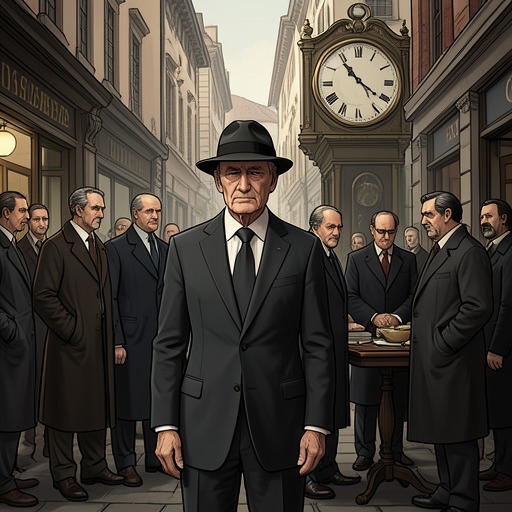
The GodfatherProhibition is the decisive historical period in which Vito Corleone's business, authority, and political imagination expand into the structure later recognized as the Corleone Family. The ban on alcohol creates an illicit market large enough to reward organization, discretion, transport, protection, and violence; by the end of the period, Vito Corleone has become Don Corleone, a power whose influence rests as much on favors and administration as on force.
From Businessman to Don
Prohibition marks the final movement in Vito Corleone's rise. Before it, he is described as an ordinary, though somewhat ruthless, businessman. The change is gradual rather than sudden: by the end of Prohibition and the beginning of the Great Depression, he has become the Godfather and Don Corleone. The period therefore functions not merely as background history but as the economic and political environment that makes his transformation possible.
The opportunity begins with the six delivery trucks belonging to the Genco Pura Olive Oil Company. Through Peter Clemenza, a group of Italian bootleggers who smuggle alcohol and whiskey from Canada approaches Vito Corleone. They need reliable, discreet deliverymen and vehicles capable of distributing their goods throughout New York City. Their fee is so large that Vito Corleone drastically reduces the oil business and uses the trucks almost exclusively for bootlegging. The offer is accompanied by a polished threat, but he neither takes offense nor rejects a profitable arrangement. Instead, he judges the threat, finds it unconvincing, and stores the information as knowledge about his new partners.
The bootlegging arrangement brings more than money. It gives Vito Corleone contacts, experience, and information, while the favors he performs accumulate like securities in a bank. Prohibition thus enlarges both his material resources and his social credit. The criminal market becomes a training ground in which he learns to convert logistics into authority and authority into durable dependence.
Protection, Secrecy, and Organization
Vito Corleone's power during Prohibition is presented as a form of protection that competes with the official order. He becomes the protector of Italian families operating small home-based speakeasies, where whiskey is sold cheaply to bachelor laborers. He also extends personal patronage into community life, becoming godfather to Mrs. Colombo's youngest son and giving the boy a twenty-dollar gold piece at his confirmation.
The organization simultaneously develops a systematic relationship with the police and judiciary. Because some trucks will inevitably be stopped, Genco Abbandando hires a lawyer with contacts in the Police Department and the courts. A payoff list, or sheet, is established for officials receiving monthly payments. When the lawyer worries about keeping expenses down, Vito Corleone insists that everyone be included, even officials who cannot help immediately, because he believes friendship should be demonstrated before it is needed. The system is therefore not a series of isolated bribes but an investment in a protective network.
As the empire grows, Vito Corleone formalizes its internal structure. Peter Clemenza and Salvatore Tessio become caporegimes, while their subordinates are designated soldiers and Genco Abbandando becomes Consigliere. Vito Corleone places layers of insulation between himself and operational acts, issuing orders through a single intermediary and rarely allowing witnesses. Salvatore Tessio's group is assigned responsibility for Brooklyn, and the two caporegimes are kept apart socially except when necessary. The separation is described as a security measure against conspiracy: Salvatore Tessio receives freedom in Brooklyn, while Peter Clemenza, considered more reckless and cruel beneath his outward joviality, remains under closer control.
This system anticipates the later explanation of Tom Hagen's position as Consigliere. The office is traditionally reserved for a full-blooded Sicilian who understands Omertà, the law of silence, because the Consigliere stands between the Don and the men who carry out orders. Prohibition-era organization thus supplies the model of command, secrecy, and deniable distance that continues to govern the Corleone Family after the alcohol trade ends.
The Repeal and the Expansion of Underworld Power
The repeal of Prohibition seriously damages the empire built around the alcohol economy, but Vito Corleone has already prepared for the next stage. In 1933 he sends emissaries to Salvatore Maranzano, who controls gambling in Manhattan, including dockside crap games, shylocking, sports and horse bookmaking, illicit poker houses, and Harlem's numbers racket. Vito Corleone proposes an equal partnership: his organization, police contacts, and political relationships would provide Maranzano's operations with protection and allow them to expand into Brooklyn and the Bronx.
Salvatore Maranzano rejects the proposal with contempt. He trusts his own organization, his relationship with Al Capone, and his connections with the Tattaglia Family. His refusal initiates the 1933 New York underworld war, a conflict that changes the structure of organized crime in New York City. The end of Prohibition therefore does not end the power it created. Instead, it forces Vito Corleone to redirect the resources, alliances, and administrative habits formed through bootlegging into gambling, political influence, and territorial competition.
The transition also reveals the limits of a purely commercial explanation of Vito Corleone's rise. His influence is sustained by poor Italian residents who ask him for help obtaining public relief, finding work for a young man, getting someone released from jail, borrowing emergency money, or persuading landlords not to demand rent from unemployed tenants. He gives assistance with goodwill and encouraging words, reducing the humiliation of charity. In return, people consult him about candidates for local, state, and national office, and he becomes a political power sought out by party chiefs. He further invests in the future by helping talented young men from poor Italian families attend college, some of whom later become lawyers, assistant district attorneys, and judges.
Legacy of the Prohibition Order
The social order created during Prohibition survives beyond the period itself. Don Corleone's favors produce obligations: those who receive help acknowledge that they are in his debt and that he may later call upon them for a small service. At his daughter's wedding, supplicants approach him privately, while guests bring cash gifts rather than checks as signs of respect and indebtedness. The scene shows how a criminal economy has become a moral and ceremonial system, complete with titles, rituals, hospitality, and reciprocal expectations.
The same logic later extends into national underworld diplomacy. Watching the approach of global war, Don Corleone seeks peace within his own sphere so that the organizations under his influence can profit from the prosperity of wartime America. By 1939 he has negotiated a working agreement among powerful underworld organizations in Los Angeles, San Francisco, Cleveland, Chicago, Philadelphia, Miami, and Boston. The agreement preserves each group's internal authority while establishing spheres of influence and a commitment to peace. The organizational imagination first sharpened during Prohibition thus expands from one family's protection network into a nationwide political order.
Don Corleone later describes this order as Cosa nostra, a world that its members will manage for themselves against outside interference. His language rejects the authority of distant officials who declare wars and make laws for their own interests, even as the Family itself relies on coercion, secrecy, political connections, and violence. Prohibition is central to this contradiction: the state ban creates the market that enables Vito Corleone's ascent, while the resulting organization presents itself as an alternative government for the people it protects.
The period's legacy remains visible even after the Corleone Family survives later wars and moves toward Las Vegas. The Family's power eventually becomes unchallengeable, its operations are redistributed among caporegimes and security chiefs, and Michael Corleone establishes headquarters in Long Beach and Las Vegas before closing the New York operation. That later consolidation depends on the architecture formed during Prohibition: transport and distribution, protected markets, political relationships, compartmentalized command, and a system in which friendship is both a personal bond and a recoverable debt. Prohibition is therefore the historical crucible in which Vito Corleone's criminal enterprise becomes an enduring institution.